Why Your LinkedIn Profile Isn't Converting Despite Real Expertise
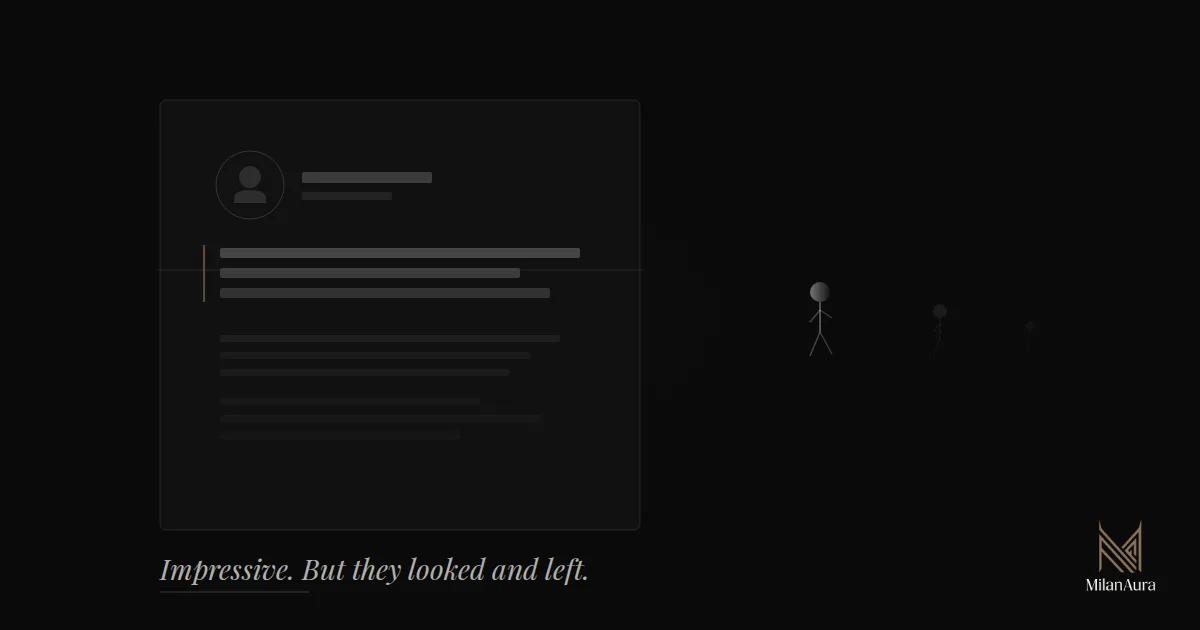
If you are excellent at your work but your LinkedIn profile does not bring you clients, the cause is almost never effort or talent. It is that your profile describes you instead of speaking to a specific buyer, and shows no proof that buyer can trust. Here is why that happens, and the first move to fix it.
There is a particular kind of professional who closes almost every meeting they get into, and loses the deal before the meeting is ever booked. In the room, they are unmistakable. Then a prospect does what nearly everyone now does before a first conversation, looks them up, and finds a profile that reads like a job history. The expertise was never the question. The profile was.
Why doesn't a strong profile bring clients?
Because a profile that lists your experience is answering the wrong question. A buyer does not arrive asking “is this person accomplished.” They arrive asking two sharper questions: can this person solve my specific problem, and have they done it for someone like me. A profile full of titles and history answers the first by accident and ignores the second. The reader thinks “seems impressive,” which feels like a compliment and is actually the most expensive place a profile can leave a buyer, because impressed people do not reach out. Convinced people do.
Isn't the answer just to post more?
No, and this is the most common wrong turn. Posting more helps only once the profile a reader lands on actually converts. If it does not make a specific buyer feel seen, more posts simply send more people to a page that does not work. You get reach without results, which feels like effort without reward. Clarity first, then consistency.
What does a buyer actually look for on your profile?
Three things, in seconds. Do you understand my world, which your headline and opening lines answer. Have you done this for someone like me, which proof answers: a named outcome, a before and after, a client’s words. And why you rather than the ten others I could pick, which a point of view answers. Most strong professionals pass the first test and fail the second and third.
Why does “written for everyone” quietly cost you?
Because a profile aimed at everyone is aimed at no one in particular. When a profile names its audience as “business leaders” or “organizations,” a founder deciding whether to contact you cannot tell it was meant for them. Staying broad feels safe, as if narrowing would turn people away. It does the opposite. The experts who convert are not the ones who appeal to the widest audience. They are the ones a narrow audience recognizes instantly.
This is the shape of Invisible Expert Syndrome, the pattern we named at MilanAura AI Studio: real expertise that stays hard to find and hard to choose, not because the work is weak, but because the signal is unclear.
Why isn't a clear profile enough on its own?
Clarity gets a buyer to the edge of trust. Proof is what they step onto. A profile can state a sharp position and still stall, because there is nothing a stranger can verify: no named outcome, no before and after, no one other than you saying what changed. One concrete proof point, told plainly, does more than a year of confident self-description. It also matters to a second kind of reader. Buyers increasingly ask an AI assistant to name the credible people in a field before they ask a colleague, and those systems weigh corroboration, not self-assertion. A profile that is clear but unproven stays invisible to the buyer and to the AI they ask first.
How do you fix a profile that isn't converting?
Two moves, in order. First, write one sentence that names exactly who you help and what changes for them, and put it where a buyer sees it first: your headline and the opening lines of your About section. Second, add one real proof point underneath it, a specific result a stranger can anchor trust to. A sharp point of view plus one piece of evidence usually does more than months of extra posting, because it gives both a human and an AI a reason to choose you rather than merely admire you. Only then does consistent content compound.
The professionals who struggle online are rarely the least capable. More often they are the least translated. The work is real. The presence just never said so clearly enough for a stranger, or the AI that stranger asks, to be sure.
Common questions
My profile gets views but no messages. Why?
Views mean your headline is interesting. No messages usually means the profile does not make a specific buyer feel it was written for them, or shows no proof they can trust.
Do I need to post every day to fix this?
No. Fix the profile first. One clear positioning line and one proof point do more than daily posting to a page that does not convert.
How do I find my own gap?
Run the free Authority Check. It takes about a minute and shows your strengths, your single biggest visibility gap, and one post in your own voice.
البنية الواضحة والدليل، لا كثرة المحتوى، هما ما يحوّل الخبرة الحقيقية إلى عملاء.
See where your own profile stands. The free Authority Check reads your profile and shows your strengths, your biggest gap, and one post in your own voice. About a minute, no card.
Run Your Free Authority Check